

Europe’s Industrial Future is on the line – The Clean Industrial Deal must deliver



The Two Job Waves of the Energy Transition: Why Early Demand Side Action Maximises Long Term Industrial Jobs
The clean energy transition has become a strategic imperative for the European Union. Escalating geopolitical tensions, the return of trade tariffs with the Trump II presidency, combined with China’s dominance across clean energy supply chains, have continued to expose Europe’s vulnerabilities in energy dependency and industrial capacity. In this context, the energy transition is no longer only a climate objective: it is central to Europe’s energy security, economic resilience, and global competitiveness. Leveraging the transition offers the EU a unique opportunity to reduce fossil fuel imports, rebuild strategic industrial value chains on European soil, and generate millions of high quality jobs across manufacturing, construction, and services.
This strategic imperative is starting to translate into concrete action at the European level, leveraging the inputs from governments and the industry. The 2026 North Sea Summit Pact marked a significant step, with nine Member States, together with over one hundred energy companies and transmission system operators, committing up to EUR 1 trillion and the development of an Offshore Financing Framework to scale up offshore wind deployment. The initiative aims to add around 15 GW of offshore wind capacity annually between 2031 and 2040, while strengthening cross border grid integration between Germany and Denmark to enhance security of supply. By aligning infrastructure investment, regional cooperation and industrial capacity, the North Sea Pact exemplifies how the EU can operationalise its energy strategy with a decarbonisation, security and competitiveness focus.
At Catalyse Europe, we argue that rapidly scaling up these flagship clean energy projects combined with coherent and coordinated legislation and implementation at the supranational and national levels notably on grid infrastructures and clean technology deployment will deliver a continent wide electrification wave delivering a competitive and decarbonised economy.
Yet a critical dimension of this industrial transformation remains insufficiently reflected in EU energy planning: its impact on employment. While EU policy debates rightly emphasise climate targets, energy security, and affordability, the labour market implications of the clean energy transition are too often treated as a secondary outcome rather than a core policy objective. This omission risks underestimating both the scale of the opportunity and the importance of aligning energy, industrial, and vocational training and skills strategies. Beyond its contribution to net zero goals, the clean energy transition is a powerful engine for job creation as clean energy value chains are significantly more labour intensive than extractive fossil fuel industries. However, the task ahead of properly managing the transformation of the workforce, both in terms of geographic distribution and skills requirements, will be complex, costly, and will require sustained attention to policy sequencing and national specific labour market characteristics. Without careful planning, this transformation risks under delivering. Scaling up renewable generation, electricity grids, storage, and low carbon industrial processes requires a large and diverse workforce across manufacturing, construction, engineering, digital services, and supply chains. As such, significant obstacles remain within current European labour market structures and energy strategies in creating the conditions necessary for the energy transition’s job creation potential to fully materialise. Yet, in 2025 alone, the EU’s renewable energy sector already supported an estimated 1.8 million direct and indirect jobs, highlighting the sector’s substantial existing labour footprint and its capacity to grow further as deployment accelerates. If properly anticipated and integrated into EU and national planning, the clean energy transition can become a cornerstone of labour market revitalisation, delivering high quality jobs, supporting industrial competitiveness, and ensuring that Europe’s decarbonisation pathway translates into tangible social and economic gains.
Against this backdrop of industrial and labour market transformation, Catalyse Europe in partnership with Evolved Energy Research, assessed the extent to which the energy transition can act as a driver of job creation across EU Member States, in a context of the growing electrification wave and persistent unemployment and skills mismatches in European labour markets. The analysis shows that, if supported by coherent policy planning and technology inclusive approach, the clean energy transition could generate up to 4.65 million net new jobs across the EU. These jobs emerge in two distinct but interdependent waves, each shaped by different investment dynamics, workforce requirements, and policy levers.
The first wave is driven by demand side electrification and energy efficiency retrofits. These activities, such as building renovation, electrification of heating and transport, and local energy deployment, are labour intensive and can be scaled rapidly in the 2020s. The second wave follows as a broader industrial expansion. It encompasses the growth of electricity grids, clean power generation, manufacturing capacity, and emerging clean technologies, and unfolds over the longer term through 2050. This wave delivers the largest employment gains, but it requires sustained investment, industrial capacity, and a skilled workforce. The most important insight of our study is that the second wave depends on the first. Concretely, early demand side action creates market certainty, investment signals and workforce mobilisation required to maximise the benefit of clean job creation. These are the conditions that unlock Europe’s longer term industrial potential.
These findings have direct implications for how the EU sequences and designs its upcoming energy and industrial policy. Unlocking the full employment potential of the energy transition depends on policy choices and freeing up the private sector to align demand, investment, and workforce planning from the outset.
To activate the two waves of employment identified in this study, EU policy sequencing should place stronger emphasis on demand side measures before supply side expansion, and explicitly integrate labour market considerations into industrial planning. While the framing of the energy transition as a pillar of industrial competitiveness has gained traction since the start of President von der Leyen’s second mandate, upcoming legislative files should go further. Key initiatives such as the Electrification Plan and the Heating and Cooling framework offer critical levers to stimulate demand side employment. Reaching the potential of up to 4.65 million net new jobs also requires a technology inclusive approach. Leveraging the full range of available clean energy solutions, renewables, nuclear, hydrogen, carbon management, and enabling technologies, offers the most resilient and cost effective pathway to 2050 net zero goals. Upcoming policy files related to digitalisation and AI in the energy sector, small modular reactors (SMRs), geothermal energy, hydrogen, and carbon capture and storage should therefore be seen not as isolated initiatives, but as complementary components of a diversified industrial and employment strategy.
The Two Waves of Job Creation
Wave 1 (2026 to 2035): Demand Side Jobs Rise First
Figure 1: Timeline of net new jobs from demand side activities under a high ambition, technology inclusive scenario. Reference lines for 2035 and 2050 for net job growth are included.
Our analysis shows a rapid increase in employment in the early 2020s and 2030s as households and businesses begin to electrify. These include heat pump installation, building retrofits, rooftop solar, EV charging and local construction and installation services. They require shorter training pathways and produce immediate labour market benefits, especially in construction and electrical trades.
The figure shows demand side jobs reaching their peak around the mid 2030s before a stabilisation period. Overall, demand side energy transition is modelled to create 1.18 million jobs through 2050. This creates Europe’s early momentum in the labour market. It also sends a clear signal to industry that the transition is real and accelerating.
Wave 2 (2035 to 2050): Supply Side Jobs Dominate Long Term
Figure 2: Timeline of net new jobs from supply side activities under a high ambition, technology inclusive scenario. Reference lines for 2035 and 2050 for net job growth are included.
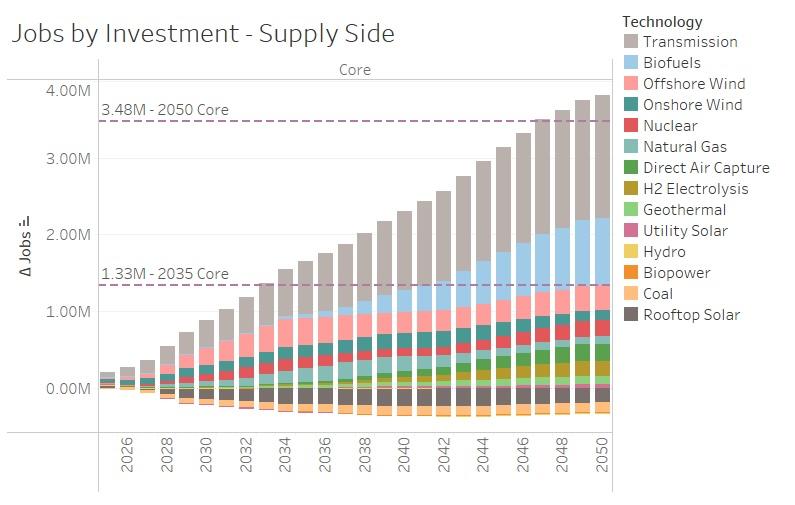
By 2050, supply side sectors generate 3.48 million jobs. This is three times the scale of employment in the first wave. It reflects the long term industrial buildout of Europe. This includes transmission and distribution networks, large renewables deployment, manufacturing and emerging technologies.
Maximising Job Potential: Demand Drives Long Term Supply
Our analysis shows that supply side growth cannot materialise without early demand side uptake. Early adoption of electrification technologies such as heat pumps, EVs, insulation and rooftop solar creates market certainty. This allows industries to invest with confidence in manufacturing plants, transmission and distribution upgrades, hydrogen and carbon management infrastructure and large scale clean power deployment. Early demand also builds public confidence, skills pipelines and installation capacity. All of these are prerequisites for a successful industrial transition.
The analysis allows to identify specific demand side enablers which can open the path towards the first wave of clean industrial jobs. Those are the key policy objectives the EU should be pursuing to unlock the job creation potential of the clean transition:
- accelerated heat pump rollouts and consumer finance options
- large scale building renovation and insulation programmes
- rapid expansion of EV charging infrastructure
- stable incentives for electrification and distributed energy
- training programmes for installers, electricians and retrofitters
- simplified permitting for small scale projects
EU Policy Implications 2026 to 2030
1. Policy sequencing for a coherent EU Industrial Policy
Building on our analysis and our expertise of EU policymaking, we believe current and upcoming EU energy and industrial files insufficiently prioritise electricity demand side enablers before further expanding clean energy supply. Due to this imbalance, the EU risks cannibalising the employment and economic potentials of the energy transition.
In this context, we believe the role of the EU should be to enable the necessary conditions for European companies to thrive within the Single Market and deliver the electrification wave. Rather than engaging in disputes over fixing electrification and clean energy supply national targets in a top down approach, the supranational would benefit from a more holistic strategy supporting the emergence of coherent national pathways towards the 2040 and 2050 climate objectives. Concretely, it implies upcoming energy files need to be thought in coordination with a deeper integration of the Single Market and of the Savings and Investments Union to allow European companies to get financed by institutional and private investments and properly scale up to deliver the energy transition.
From this perspective, forthcoming energy files as the revision of the Energy Efficiency Framework, the Electrification Action Plan and the Heating and Cooling framework, designed to accelerate heat pump deployment, large scale building renovation and electrification across end use sectors, are a first step towards electricity demand side enablers.
Yet, the EU is deploying significant policy and financial efforts on the supply side to develop a more interconnected, efficient and resilient energy infrastructure. In particular, the Grids Package and the Connecting Europe Facility aim to address structural bottlenecks by simplifying permitting procedures and enabling public and private financing of energy infrastructure. This is central to allow European companies in coordination with Member States to deliver energy infrastructure competitively. In parallel, several upcoming and existing EU files focus on expanding the supply of clean energy technologies, including hydrogen through the Hydrogen Strategy and Hydrogen Bank, nuclear through the Fusion Strategy, as well as broader clean technology deployment via the Clean Energy Investment Strategy, the SMR Communication and the Innovation Fund.
While we recognise the long term benefits of these supply side proposals and policies, our study shows that priority should be given to demand side enablers in the near term in order to fully unlock the employment potential of the energy transition. In particular, none of the measures cited above sufficiently address training programmes for installers, electricians and retrofitters, despite the fact that this human capital constitutes a critical precondition for any large scale electrification wave in the European Union.
2. Integrating EU Workforce Planning into EU Industrial Policy
While the EU is explicitly tying its industrialisation with decarbonisation objectives, it must also focus on preparing the workforce to meet emerging clean energy demands.
The CID has already taken a step in that direction, by introducing its Union of Skills, a strategic initiative designed to equip the workforce with the necessary skills for the clean energy transition and to bolster competitiveness. The initiative focuses on reskilling, vocational training, skills mobility, and attracting talent while aligning education systems with industrial needs through initiatives like the Pact for Skills and micro credentials. However, while this represents a significant recognition of the need to embed workforce development into the EU’s industrial strategy, more can be done in the future. Tailored national frameworks are needed to match local workforce needs with evolving and emerging industry demands. A “one size fits all” approach will not meet the diverse needs across Member States. Instead, they should be supported and incentivised to develop national workforce strategies that integrate clean energy skills planning into their own industrial and economic development frameworks.
Moreover, the EU should scale up existing programmes, and prioritise the integration of large scale upskilling and reskilling initiatives in industrial policies, particularly in transitioning regions. Expanding programmes like the Pact for Skills to facilitate worker mobility and integrating workforce targets into Member State industrial strategies will ensure a smooth labour transition.
3. Technology inclusive approach to cleantech
Finally, a technology inclusive approach is key to unlocking the maximum job creation potential identified in our study. Supporting and financing the deployment of a broad range of clean technologies over the medium to long term is a necessary condition for an efficient, resilient and employment rich energy transition.
Firstly, while the EU has recently made progress towards a more competitive clean energy strategy through the Clean Industrial Deal and several upcoming legislative proposals outlined above, regulatory complexity continues to delay the deployment of key technologies such as hydrogen, geothermal energy, carbon removal and advanced nuclear, despite their central role in achieving long term decarbonisation and job creation. These technologies still face unclear approval processes, fragmented and inconsistent permitting rules across Member States, and insufficient integration into national energy planning frameworks. The EU has acknowledged these challenges and can build on existing and forthcoming tools to act more decisively, notably through the effective implementation of the Net Zero Industry Act to streamline permitting for net zero technologies, and the upcoming Industrial Accelerator Act, which is expected to place a strong focus on industrial permitting. This latter instrument will be particularly instrumental in accelerating the deployment of domestic clean manufacturing capacity across the Union.
Secondly, despite ambitious clean energy and climate targets, Europe’s research, development and innovation landscape remains fragmented across Member States and EU institutions, limiting scale, coordination and impact. A more coherent EU level framework would help streamline funding instruments, set clearer innovation priorities, and ensure that critical technologies receive consistent and predictable support. This objective should be reflected in the design of the next Multiannual Financial Framework, with stronger and more strategic backing for clean energy research and innovation. Existing programmes such as Horizon Europe should also be further leveraged, particularly given the Commission’s plan to allocate €600 million under the 2026 to 2027 Work Programme.
Thirdly, and perhaps most critically for clean technology deployment and job creation, EU policy should increasingly shift its focus from start up creation, where Europe already performs relatively well, to the scale up, industrialisation and commercialisation of clean technologies. While Europe hosts a vibrant and growing clean tech start up ecosystem, the main gap lies in supporting scale ups and “nth of a kind” projects that bridge the path from innovation and market deployment. Recent initiatives such as the Scale up Innovation Fund and the European Innovation Council represent important steps in this direction by providing capital, blended finance and equity support to high potential companies. Strengthening and expanding these instruments is essential to ensure that innovation translates into industrial capacity, sustained employment and global competitiveness within the EU.